
Flexible moulding for an arch: how to create one
The arch is back in interior design. Older European homes always had them: soft, curved doorways between rooms. In modern new builds the arch is exactly the shape people bring back to soften all those straight lines. An arch turns a doorway into a moment and a blank wall into a composition.
Yet most arch plans fail at the same point: traditional moulding is dead straight and rigid. You cannot bend a wooden or hard plastic moulding around a curve, and custom plasterwork is beautiful but expensive craftsmanship. That is exactly why we developed the Flex Moulding: a flexible wall moulding that bends along any curve, is self-adhesive and paintable, and goes up without a professional. Here is how it works in short:
Prefer the full walkthrough with photos? See our step-by-step installation guide for mouldings and arches.
What can you do with an arch? Six ideas
An arch is not just a doorway. Most arches our customers create sit right on the wall, as a shape that makes a room softer and more personal. These are the six applications we see most often.

The stately doorway
A curved doorway framed with a classic profile looks like it has always been there. Finished with limewash or concrete-effect paint it takes on a timeless, almost Mediterranean character.

The wall arch as a focal point
An arch of Flex Moulding right on the wall, here filled with a graphic wallpaper. Perfect behind the dining table, above a sideboard or as a headboard effect behind the bed.

The triptych
Two or three arches side by side give a long, empty wall rhythm and symmetry. Perfect in the living room or hallway, with a mirror or wall light inside each arch.

The bathroom curve
A soft curve comes into its own in the bathroom. The moulding is paintable and handles higher humidity, so it can match any colour your bathroom already has.

The tone-on-tone arch wall
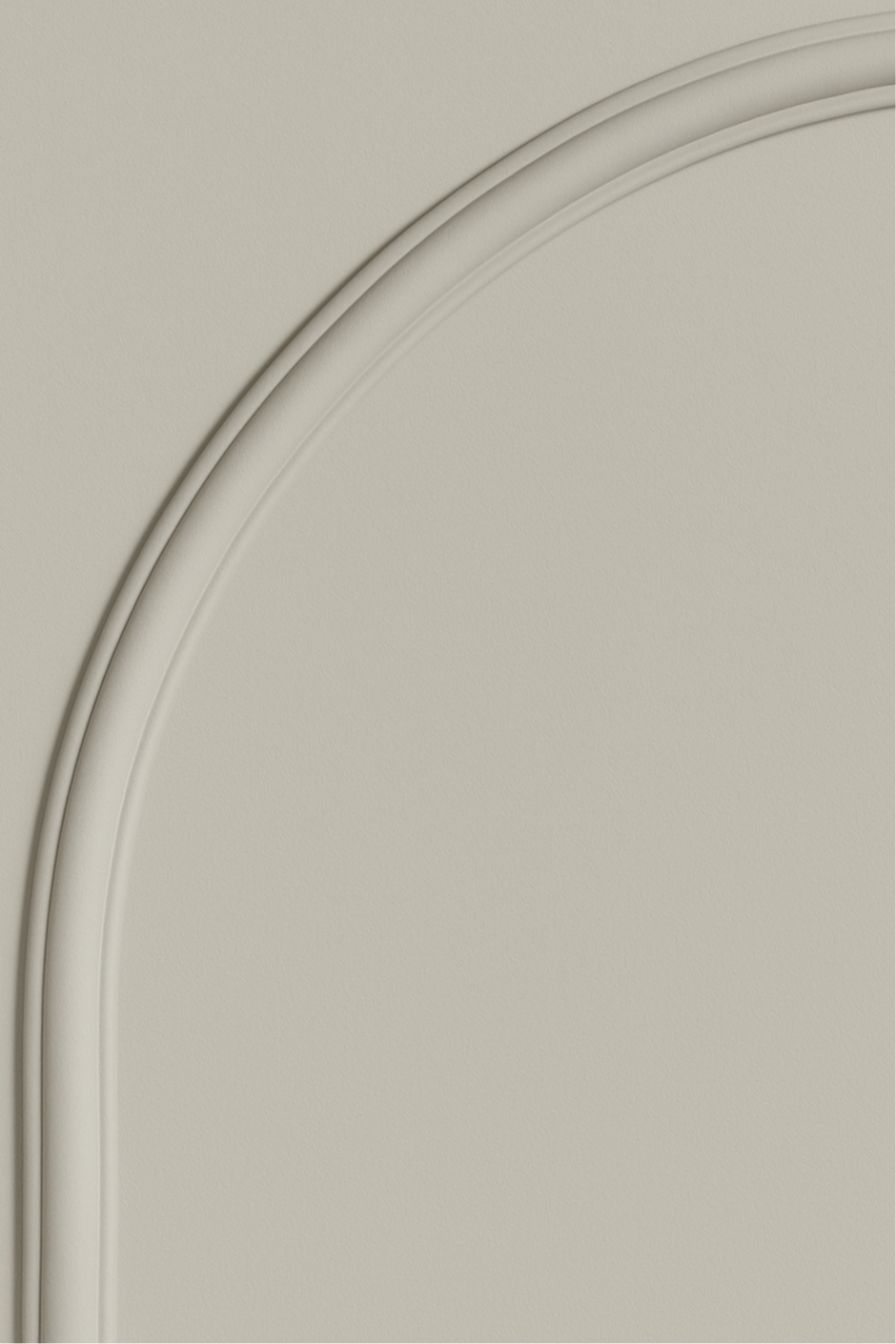
Tall, slim arches side by side, painted in the same colour as the wall. The shape lives purely through shadow play: calm yet full of depth, at its best in a Japandi interior.

The organic shape
If you dare to go beyond the half circle, a curved moulding lets you create flowing, organic shapes. The moulding follows any line you draw, so your design is the only limit.
Which look will you give your arch?
All four of our profiles bend along any arch. The difference is what the profile does to the curve: the same arch changes character completely with a different profile on it.

Nova: modern
A rounded core between two crisp edges. Gives the arch a modern, architectural frame.
View Flex Moulding Nova
Crown: classic
A layered profile with multiple shadow lines. Turns the arch into a stately statement, like original plasterwork.
View Flex Moulding Crown
Classic: timeless
A gently waved, elegant profile. The middle ground that suits almost any interior, from hotel chic to Japandi.
View Flex Moulding Classic
Luna: organic
One fully half-round shape without edges. Lets the curve itself tell the story, soft and organic.
View Flex Moulding LunaFrom real homes
More than 450 interiors went before you, and a large share of them started with an arch. Two stories that show what is possible.

Wim's Italian archway
Wim built an archway in Italy himself from aerated concrete blocks, had it plastered and finished the curve with our flexible mouldings. For the finish he treated them with a mix of plaster and diluted exterior paint, so moulding and wall became one stone-like whole. The mouldings are designed for indoor use, but his approach shows how far a good idea can take them.
Three Crown arches on one wall
A German customer divided a wall of 288 by 240 cm into three symmetrical Crown arches of 80 by 200 cm, with 12 cm in between and 40 cm to the ceiling. The measurements came straight from the calculator: three rolls, three arches, one afternoon of work. Proof that a crisp triptych needs a good plan, not a contractor.
How many metres do you need?
Simpler than you think: one 6 metre roll covers one standard arch up to 100 cm wide and 210 cm high, including the 10% cutting margin we recommend. That covers the vast majority of doorways and wall arches. Creating a floating arch, one that does not start at the floor? Then a horizontal base piece is added that is at least as wide as the arch itself, so keep the arch to a maximum width of 80 cm per roll. For other sizes, every product page has a calculator that converts your measurements straight into the number of rolls. Finishing several arches? An Arch Bundle is the better deal: simply pick three, four or five arches and the volume discount is already included.
The arch through time: why it never disappears
The arch is one of the oldest shapes in architecture, from Roman aqueducts to cloisters and the archways of Mediterranean village houses. It defined the doorways of countless early twentieth century European homes, then disappeared for decades behind straight frames and flat walls, until the organic modern movement and the revival of Mediterranean interiors brought it back. Today the arch is the fastest answer to a home that feels too angular: one curve softens an entire room.
That also explains why the arch works so well in otherwise minimal interiors. Our brain finds visual calm in rounded shapes; an arch breaks the hard lines of frames, cabinets and screens without adding clutter. And you do not have to renovate for it: a drawn arch with a flexible moulding around it does exactly the same work on a flat wall as a real niche.
Colour and paint: making the arch speak
The moulding is matte white and paintable with any wall paint, and that choice defines the result. Paint the moulding in the wall colour and you get a subtle relief that lives through shadow play: calm, high-end, almost like plasterwork. Choose a contrasting colour inside or around the arch and it becomes the centrepiece of the room. And with limewash or concrete-effect paint over both moulding and wall you get that mineral, southern look you know from Ibizan and French interiors.
Why Velida?
Velida was born from exactly this search. Founder Elise was looking for a moulding for the arches in her own interior, discovered the concept of flexible moulding in the United States and developed it into our own Flex Moulding. Today we give free advice every day to customers planning their first arch, before and after their order. Unsure about sizes, profile or approach? Send us a photo of your wall and you will get concrete advice in return.
Frequently asked questions
Can a flexible moulding follow any curve?
Yes. The Flex Moulding bends smoothly along half-round arches, gentle curves, wavy shapes and rounded walls. On tight curves it pays to work slowly and press the moulding on evenly, so the tension spreads neatly across the curve.
How many rolls do I need for one arch?
For a standard arch up to 100 cm wide and 210 cm high, one 6 metre roll is enough, including 10% cutting margin. For a floating arch the horizontal base piece is added; keep the arch to a maximum width of 80 cm so everything comes out of one roll. For other sizes, use the calculator on the product page.
Can I paint the moulding in another colour?
Yes, all profiles are matte white and paintable with any wall paint, including limewash and concrete-effect paint for a natural, mineral look.
Which profile suits my interior?
Nova is modern and graphic, Crown is layered and classic, Classic is timelessly elegant and Luna is soft and fully rounded. In doubt? Send us a photo of your room and we will gladly advise which profile suits it best, free of charge.
How fast will I receive my mouldings?
Order on weekdays before 21:00 and your order ships the same day. Delivery time depends on your location in Europe, so you can plan your arch weekend ahead.
Ready to create your arch?
Choose the profile that suits your interior, or ask us for free advice on your design.
View all flexible wall mouldings